
By: Atty. Lj Ramos
The Supreme Court has approved amendments to the Rules of Court to make it easier for Filipino spouses to prove a foreign divorce when seeking its recognition in Philippine courts.
Under the amendments, Filipino spouses seeking recognition of a foreign divorce under Article 26(2) of the Family Code will no longer need to prove the applicable foreign law when filing their petition. They will only need to prove that the foreign divorce took place.
To clarify, the Supreme Court did NOT legalize divorce. It only provides amendments to the framework that gives effect to Article 26(2) of the Family Code.
Under Article 26(2), where a marriage between a Filipino citizen and a foreigner is validly celebrated and a divorce is thereafter validly obtained abroad by the alien spouse capacitating him or her to remarry, the Filipino spouse shall have capacity to remarry under Philippine law.
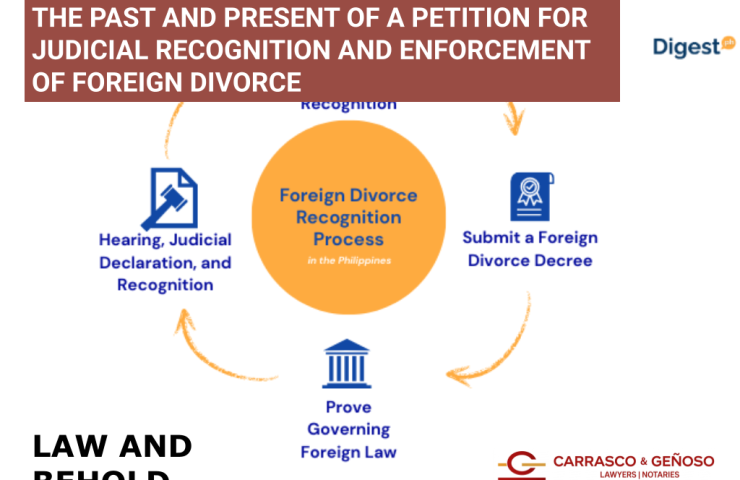
Prior to the amendments, to have the divorce obtained abroad by the alien spouse recognized in the Philippines, the Filipino former spouse still has to file a Petition for Judicial Recognition and Enforcement of Foreign Divorce. In the said petition, the former spouse must prove both the divorce decree and the governing personal law of the alien spouse who obtained the divorce because the Philippine courts do not take judicial notice of foreign divorce judgment.
To prove the divorce decree and the governing personal law of the alien spouse, Rule 132, Section 24 and 25 of the Rules of Court would apply. First, the petitioner has to provide an authenticated divorce decree, by either an official publication, or a copy thereof attested by the officer having legal custody of the document. If the record is not kept in the Philippines, such copy must be (a) accompanied by a certificate issued by the proper diplomatic or consular officer in the Philippine foreign service stationed in the foreign country in which the record is kept and (b) authenticated by the seal of his office.
Second, the petitioner also has to prove the applicable law on divorce in the country of the foreign spouse. This is where the challenge lies.
Multiple cases have reached the Supreme Court where the petitioner failed to authenticate the foreign law allowing divorce. The Office of the Court Administrator tried to remedy it through OCA Circular No. 157-2022-A, by providing a Compilation of the Laws of Foreign Countries on Marriage and Divorce. But the Supreme Court held in Republic v. Ng (G.R. No. 249238 February 27, 2024) that the OCA Circular does not dispense with the requirement for petitioner to comply with the rules on proof of foreign laws.
Foreign family laws are often spread across different jurisdictions, making them difficult to obtain. Some countries have no designated official who can certify these laws, while foreign ministries generally do not provide official English translations.
However, with the amendments, the Supreme Court recognized that proving foreign law under the existing rules can be difficult for Filipino spouses, particularly overseas Filipino workers.
With these amendments, the Supreme Court said that it aims to remove unnecessary barriers and make it easier for Filipinos to exercise their rights under the law.
(Disclaimer: This material is provided for general legal information only and is not a substitute for legal advice. Its application depends on the particular facts and circumstances of each case. The views expressed by the author do not necessarily reflect those of the firm, its partners, or its associates. The photo used is attributed to Digest.Ph, published 22 September 2025.)


Leave a Reply